RECOVERY D.O.C.
Definition Of Confidence Recovery
1 The current dilemma & Cognitive Dissonance
Our definition of confidence:
“Someone who does exactly what they say they’re going to do it, exactly when they say they are going to do it”
I believe that all of us here started with one simple and obvious goal.
“I’m not going to use anymore”
I’m going to assume that we thought this every single Monday whilst nursing a severe come-down/hangover.
I’m then going to assume that Tuesday was also terrible, picking up the pieces from Mondays day off work, ordering a new screen for the cracked iPhone 13 in your pocket and deciding which of the weekends 32 missed called from worried loved ones we were going to return first. At this stage, we hate use, we hate what it does to us, and we hate who we have become.
And then, by Wednesday, as is the way, we started to feel a little better as the week went on, damage control was complete and our chemical imbalances were starting to balance quite nicely. But still, f*ck drugs and alcohol, I’m never going to use again.
By Thursday; A slightly dry mouth, a little tingle in the back of the throat or a little whiff of a passers-by joint and suddenly we are starting to forget ourselves.
And then Friday, well, here we are again, 3 for 100, a warm plate and some randomers kitchen watching as other party go-ers drop off one by one to go to bed. We’ve been here since Friday, it’s now Sunday morning and the sun is rising through the curtains, and those damn birds won’t stop making noise. Here we are again.
This, for a lot of us, can be a decades long self-fulfilling prophecy that leads to heartache.
So, every week, if not every day, we have started ourselves headed to failure.
Our ambition to never use again didn’t make it past five days, that’s really a pretty poor attempt at never. Each time we have done this, we have chipped away at our self-belief, our confidence and in the end, we just stopped fighting the urges because they always seem to win.
Cognitive Dissonance
This term is referring to our actions not aligning with our values. Despite our desire to get better, our continued use bludgeons this desire and creates fractures in our self-worth. This term is pretty well highlighted in the scenario above. We believe that by better aligning our actions to our values, we will overcome our urges and achieve our true potential.
We need to get a few wins under our belts, and I believe we are well placed to do so!
2 Values and progress
Every single argument we’ve ever had, everything we’ve stood for, fought against and believed in comes from our core-values. They are the building blocks of our personality, they affect our goals, ambitions, personality and relationships. They are as important a part of our character as anything else there is. However, few people have actually taken the time to think about what they are. So, let’s do that.
I want us to pick five values, that we believe mean the most to us. I’m sure the facilitator is going to ask the audience, and we can pick five lovely wholesome words to describe who we believe ourselves to be. But my values will differ from yours, and yours from the next person – So take the time to write these out for yourself, even discuss it with some people who know properly know you and get their opinion.
Your five values
Here they are – the very building blocks of US. So now we are sat here all warm and fuzzy with a lovely description of who we believe we are.
For our next trick, we are going to write the word USE above these values and use a + or a – to see how they are affected.
USE
I am going to assume that our use has negatively affected at least 4/5 of our values. I am free to assume this because we are all reading up about recovery, and if our use hadn’t shafted our values, we’d probably be down the pub.
Unfortunately, what we have learned is that our highest value isn’t actually the nice fuzzy list, its use. If we continue this way, nothing will change and we will have nobody to blame but ourselves.
What we are going to do now is put the word RECOVERY above our values and use the same + or – to see how they are affected:
RECOVERY
Oddly enough, I am confident in guessing that all of our values are increased by putting our recovery first, taking the time to work on ourselves and doing the work we need to do to get better.
3 Little wins
I bought a saxophone not long after I first heard Baker Street by Gerry Rafferty. It is considered one of the best saxophone solos of all time.
I was unable to play it instantly and therefore have a rotting saxophone in my loft.
Imagine walking into a gym, putting two plates either side of a barbell and arrogantly lying down, lifting it off the stand and expecting to be able to lift it. – You’re going to get crushed.
What we will do, is actually pick a self-improvement goal that’s so inconsequently small, so dismally easy that it’s hard to believe we didn’t do it already. Something that as long as you have hands, you are capable of (and frankly, even if you don’t.) Something that we have rather arrogantly deemed as a change “not big enough to warrant making.”
Something like:
- Brush my teeth twice a day
- Make my bed every morning
- Eat 3 square meals
- Drink enough water
- A 20-minute stroll around the block every day.
We are going to set this goal and give it a target of one week. And we are going to smash it (aren’t we!) At the end of the week, we will take some pride in the work we have done, we have made a start on bettering ourselves, even if we have used, we have made progress. We can continue this week after week, even during use. And each time we are comfortable it’s now a habit, we can add the next one.
Before you know it, you could well be a fully functioning human being whose physiological requirements are all being met, has decent hygiene and is forging connection with the outside world!
We view discipline kind of like a muscle, it requires training. If we want to quit our drug of choice, play baker street or lift heavy weights – we first start small and progressively load ourselves working our way up to these ultimate goals.
This way, we are building our confidence, increasing our discipline and not facing failure at every hurdle.
We have always been capable of overcoming our urges, but overreaching from the get-go made it seem impossible. Let’s realign our actions to our values, start looking after ourselves and get ready to tackle this!
4 “I will do the work when I feel better”
Short chapter this one
You’ll feel better when you do the work, not the other way around.
5 About a friend
I don’t believe that anyone has ever managed to “shame themselves sober.”
If we are looking to increase our confidence, this is clearly not the answer.
For this exercise I’d like us to take a bit of a sad journey. I’d like you to imagine someone you care for, a close friend or a relative. I’d like you to picture them in their car, 04.36am by the side of road with a bag of powder or a bottle of spirits. Too afraid to go home and face letting people down again. Too ashamed to talk to people and crying into the palms of their hands wondering if it’s worth living this way.
I’d then like you to consider if this person called you to talk, and to let it out, would you consider them a burden? Would you dismiss them or tell them they got what they deserve?
I don’t think you would.
I think you’d be elated that they chose to talk, that they trusted in you to reach out and that their vulnerability is not something you have been shouldered with, but something for you to stand alongside and support.
“I’d rather speak for 3 hours on the phone than for ten minutes at your funeral”
Sounds obvious, doesn’t it?
How come, when it was us in the former image, when we were that person who was too scared and ashamed to reach out, we deemed ourselves a burden? We deemed ourselves as unworthy of support? We deemed ourselves unworthy of saving?
It’s nonsense and a trick our brain plays on us.
Next time you hear yourself talk about yourself with such disdain, you must remember that you are your friend, you are someone worth caring for. By yourself and by others and that all the people who have offered to help along the way, want to do just that. You’re not “protecting them from you.” If they wanted protection, they would surely seek it. What they want now and have always wanted is to be trusted to help you when you need it and for you to know that they care deeply for you, regardless of what states we get ourselves in!
Learning to talk kindly about ourselves is our primary weapon against shame and guilt
6 Putting Recovery First
Okay so, we previously spoke about “putting recovery first” and I am aware that is a little… hollow.
Most of us in early recovery really are lost. We’ve lost track of everything we care about; we have prioritised our use and have this massive mountain of getting clean and sober glaring at us. This is daunting and even knowing where to kick off can seem insurmountable.
Let’s give ourselves a starting point.
Draw an 8 pointed cross on a piece of paper, in fact – I’ll make it easy for us.
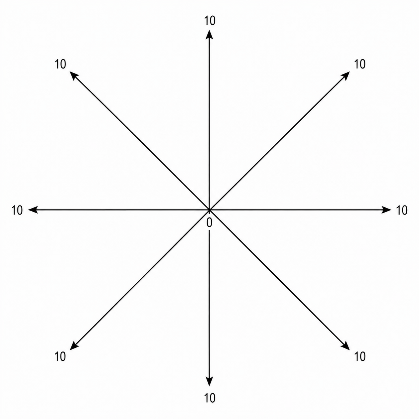
Take your five core values from the previous task and then think of a further 3 things that you think are important to your recovery. Write them at the end of each line. Our centre point “0” is the basis of our new “effort-o-meter” with 0 being no effort at all and 10 being maxed out super effort.
Grade your current self on these new values with the attention and effort each one is currently receiving from you. Place a dot on the graph at where you believe you currently are and then join the dots together. I believe you will end up with something like this:
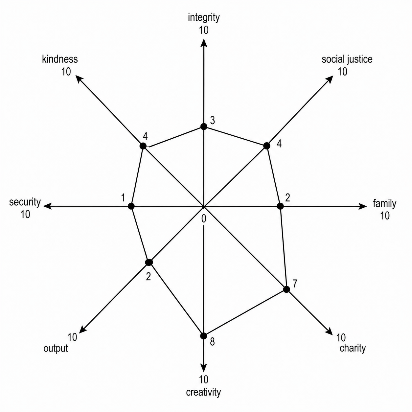
Chances are, we have a pretty poor attempt at a circle, we do however have a decent starting point. Pick whatever value was closest to zero, and list five things you can do to make progress in that area. Make sure you follow out the tasks you set yourself. Once complete – onto the next!
The aim here is balance, not 10’s all around. We want a perfect circle if we can!
7 The boat
I’ve often said that if you finally die and meet what deity you deem suitable at whatever pearly gates or green meadow you have decided best fits you and they ask, “What did you do with your life?”
If the best answer you can give is “well, I didn’t drink for 25 years”
Frankly, you should have… as you’ve missed the point entirely.
The aim of recovery is not to remove something; it is to recover the time wasted and plough it into realising your true potential and maximising our short time on this earth!
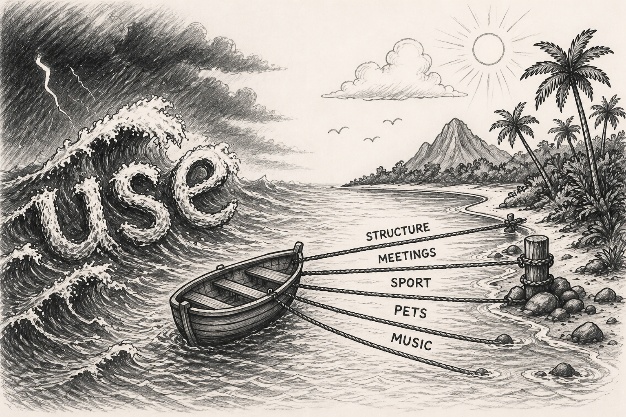
We are going to start with a small childish doodle of a boat in the middle of a piece of paper. This can be any boat of your choosing.
This boat is you.
As in reality, a boat is often tied to land. One side of the boat is facing the ocean, the other is tethered nicely to solid ground.
In this lovely little metaphor, I want you to picture the ocean as use. Not just use, but the very worst of where we ended up; alone, drained, broken with nothing to live for. Crying on our own at 3am, resenting the sunset and wondering how we are going to get out of this mess (again.)
On the other side of our little boat, is dry land – Recovery shores! Sunny, balmy coastlines filled with pride, progress, connection and security.
Now, we need to tie our boat to land. We need to identify what things have done well in keeping so sober so far and add them to the little ropes we are going to draw keeping our boat nice and safe.
A common nautical mistake is to have too few ropes tying your boat to shore.
If you are relying on “mutual aid meetings” as your only rope to Recovery Shores, what happens if something affects that, such as its cancelled or you move?
We need to ensure we forge multiple ties between us and recovery – the real reasons we want to be sober and the things that helps us keep out of trouble – could be all kinds of thing, and these are specific to you so I really do encourage you to use the drawing below and figure out your ropes.
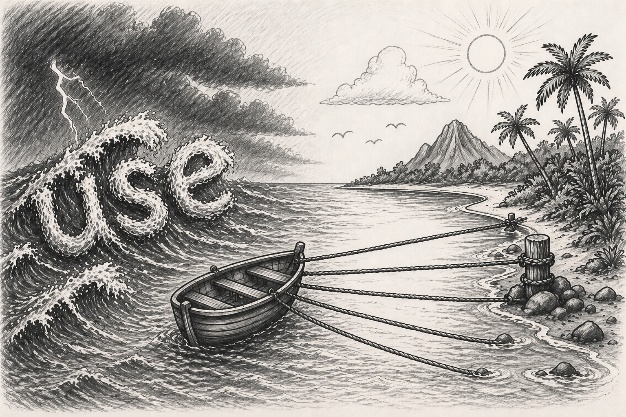
Now that we know our mooring lines, ensure you maintain them. If you leave these ropes unattended, there is every chance they will rot and diminish. Just like real life.
Frequently check on your little boat, it’s more important than you know
8 The salesman
I don’t know about you, but the little urge in my head became entirely separate from my primary conscience, he was almost sentient. He has a lifetime of sales-experience and is a master of objection handling.
On too many occasions I fell sucker: “this time will be different,” “just get a half,” “just go for one.”
I want us to humanise this little voice, to give him a persona. Our first step is a name, you can pick anything you like – Mine was “The salesman” because he was a double glazing, used car slippery piece of work. I’ve also heard; The serpent, bad-dan, the Nazgul and even Maggie from a chap not so keen on Thatcher.
So now this little creep has got a voice, we can learn how he speaks. What words does he use, what chinks in our armour does he try and weaponize to convince you to use this time.
This guy really has done a number on us if you think about it, and every time he’s won, he’s got a little stronger. Well, we say no more!
The next time he chirps up, what I’d like us to do, is take his lies and run with them using our historic evidence.
“Why don’t you get a half oz, that way you can sell it at the wedding”
Okay so, the last few times we attempted this what happened?
- We got a big bag
- We decided to test the bag
- We sniffed the big bag
- We turned up to the function after being awake for 4 days and made a tit of ourselves
“I’m sure you can just go for one pint with the boys, its sunny!”
- Went to the pub and had one pint
- It was tasty so had 2 more
- Got a half because, you know, the squad.
- Sniffed the half, bought two bottles of wine, another gram and promptly went home
- Ended up alone covered in vomit on your bathroom floor.
“It’s been like a month, surely you can have a pint!”
- Had a pint
- Three-month relapse
I’m sure you get the gist of what I’m trying to say. Present the salesman with the facts and each time you ward him off, you’ll be getting stronger and he’ll be getting weaker.
Even just delaying use by an hour can be the difference between success and lapse!
If nothing else, at least being able to argue with this being gives us a feeling of autonomy and helps delay the urge/use kneejerk reaction!
“The salesman is a liar, he will lie to confuse us, but he will mix truth with the lies to attack us!”
9 The pocket interruption paper (P.I.P.)
Our best weapon against the salesman is evidence. Previously our little voice has been allowed to run amok and hijack our decision making. This is partly through a desire to let him do just that, alongside the contrast of our diminished confidence and his 100%-win rate.
We need to better present our evidence when confronted with the tricks and lies to convince us to use!
Sketch this little chart and we can begin!
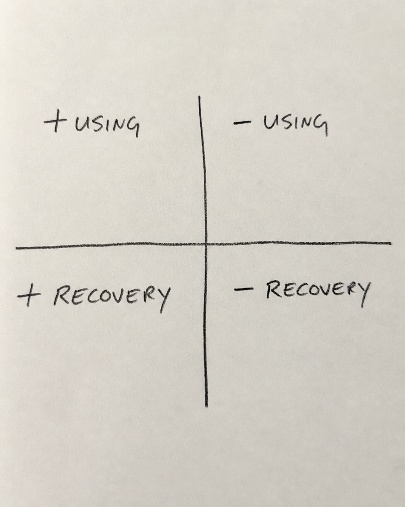
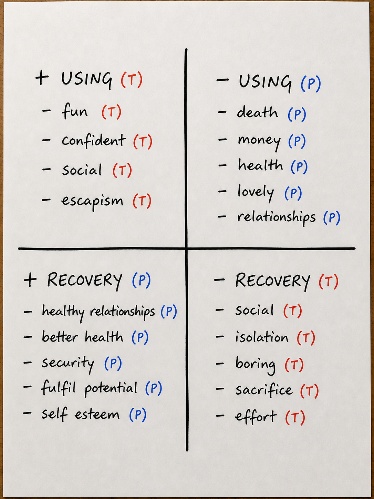
- Write the pros of using in the column
- Negatives of using in the next
- Pros of recovery in the next
- Negatives of recovery in the final square
None of us used drugs and alcohol initially because it sucked. It was fun, probably fun for ages as well.
I really don’t think we should try to forget all the great memories made whilst under the influence, they form a massive part of a character and forged some connections that probably got us through some pretty rough times! Dropping a quarter G of Mandy and then watching the chuckle brothers at bestival will stay with me forever.
If using had stayed fun, you wouldn’t be reading this. The end result of our use was inevitably tragic, lonely and covered in blood, shame and vomit. Recovery is better, the proudest most wholesome moment of the present and the future are here. Unfortunately, it’s also not easy and comes with some massive changes.
Once this is done, assess each entry and decide whether you feel it’s a “Temporary” or a “Permanent” consequence.
If we want everything to end up terrible, we can just keep using but if we sustain our efforts in recovery, it might not be so bad.
There it is, conclusive evidence that the only potential endgame of use is all the negatives, and if we stick at recovery the negatives will drift away and we will be left with only positives!
Keep this in your pocket and wave it at your salesman’s face next time!
10 The transtheoretical model
Some word, eh?
Don’t panic, it’s basically describing how people change over time.
The best thing about knowledge and learning is that it’s really, really hard to “unlearn” something. This gives us a huge edge when it comes to getting better, because each time we make in-roads into our recovery, that knowledge is now something we have.
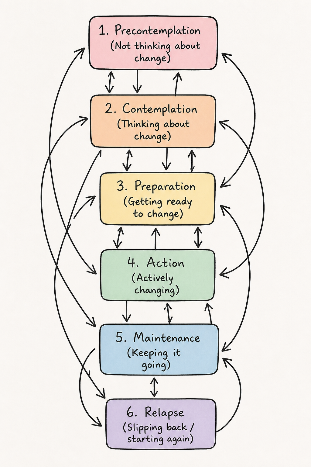
Reality is, that when we try and get better it won’t be linear. There will inevitable be lapses, relapse, stages of maintenance and maybe even trips back into pre-contemplation.
The beauty here is that all of you, every last one, are already clearly approaching action (if not already there!) so let’s all give ourselves a little pat on the back for that.
Each time we are in action, we are setting foundations, gaining knowledge and enabling the bits of recovery that really work for us. And if we do lapse, we are better placed to pick up that same ball and run with it!
You haven’t failed; it’s just part of the process!
Imagine a brick road, leading straight to the very darkest depths of our addictive behaviours, I’m talking the real nitty-gritty of it. Every time we used, we added a little brick to that road, and it became paved, easy to use and super convenient. Each time the little voice beat us, and we caved to another sesh, another little brick was added, and on & on & on until eventually this road appears to be the only road we have, carved over years of hard work.
Now, imagine another brick road, leading to that sunny paradise from before “Recovery Island” with our friends, family career, potential, confidence and hope. This road is currently not very well laid out; we haven’t got much experience laying the bricks here. However, each attempt at recovery, each time we beat an urge using the tools, each time we gain a positive experience from making better decisions – A brick gets put down.
No matter what we do, these roads will always exist, we have built them! Our job is to keep adding bricks to recovery road, until it becomes the path most travelled, more convenient and more appealing than the other!
No matter how far into recovery you go, that road to use will still remain, but after time it becomes clear what a tatty old path that is and how much more appealing our new Recovery Island Superhighway is looking!
These “Roads” are your brain’s Neuropathways.
11 What’s a £50 note worth?
If I was to hand you a nice crisp £50 note, I’m sure you would say “thank you very much!” and then pocket that fifty and think what a nice chap I am.
If I was to take another £50 and throw it on the ground, I’m sure you would pick it up and say, “thank you very much!”
Another £50, this time I’ve got serious… I’ve scrunched it up, ripped it, rubbed it in the mud, left it outside in the cold, dark wilderness for a few weeks. However, when presented with the note it’s still “thank you very much!”
Regardless of what external influence I impose onto this note, the fact remains that it’s £50 and is still decent money!
This is a crappy piece of polymer with a face and a number on it. What if it were an actual person, just like us!
The point I’m making here is that no matter what you’ve been through, no matter what anybody else has ever done to you, you carry MASSIVE intrinsic worth. It can’t be defiled; it can’t be taken from you. Your worth and potential will exist as long as you do, this makes you someone worthy of saving. Best we start acting like it, eh.
12 The many, many acronyms of recovery
Over the years I’ve heard so many acronyms to help us during moments of crisis. I’ve been original and come up with a new one, write these on all your stash spots and keep them front and centre in your brain during moments of crisis!
You know what, you know you better than anyone, pick a few punchy words like ACT, USE, STOP and assign words that you think might help divert you during a crisis, by using your own language you may even listen to yourself!
ANCHOR
(Keeping the boat theme)
- A
- Acknowledge the urge
- N
- Name what you’re feeling
- C
- Connect to your values
- H
- Hold steady (breathe)
- O
- Observe without reacting
- R
- Respond, don’t react
ACT
- A
- Acknowledge
- C
- Choose a tool
- T
- Take action
STOP
- S
- Stop
- T
- Take a breath
- O
- Observe the urge
- P
- Pick a tool
13 Why the f*ck it button is a myth
Out of curiosity, have you ever allowed a small slip to become fully fledged relapse?
I know I have, even “accidentally” fell into a cheeky bump of packet and decided that my 100-day streak was ruined.
Our new philosophy is that streaks are something we are proud of, but not something we value. Try and think of every day sober as a shiny £1 coin put into a sealed piggy bank. Each day we manage to abstain from our D.O.C. we get to add another quid to the jar.
If one day, I don’t get so lucky as to put my shiny golden nugget in the jar, because I’ve slipped… Does that remove the other coins from the kitty…? it does not.
The term is known as the “Abstinence Violation Effect” and it’s been around since the 80’s. We really aren’t that special. The salesman convinces us that the half pint of stella is catastrophic and because we have ruined our streak, we may as well tear the granny out of it. This trick forces us into longer relapses and damages our confidence.
Preventing a lapse from becoming a relapse is fundamental to our success, especially in early recovery.
Nothing that you do can take those coins from the jar, you’ve earned them and they are yours to keep.
Maybe consider taking the number of days that you’ve used away from your streak:
“I was sober for 70 days and then used for 2, that’s still 68 days”
This little reframe really does highlight the progress we’ve already made.
14 The smartest things I’ve heard in meetings
Over the years I’ve received council from all kinds of people. It’s the one room on earth I’ve seen millionaires sit on a level playing field with the homeless. Left-wing/Right-wing political advocates and all races, religions and sports-team supporters united. The most empathy and connection poured into one ragtag bunch of degenerates. Below is just some of the wisdom that comes to my mind.
- “I thought they were trying to take everything from me, but they were trying to take one thing away and give me everything else”
- “I was trying to protect my loved ones from me, and in doing so was causing more harm than just letting them in”
- “Using drink//drugs to handle complex emotions is incredibly short lived and often just numbs the experience rather than you actually processing and earning to live with/learn from them”
- “I think I’d rather have coffee flavoured sausage, than sausage flavoured coffee – but its close”
- “Guilt/shame don’t actually roll up notes and shove them in our face, going through the tools and learning to cope with these thoughts helps with the actual action of using alongside helping to manage the triggering mental health side of things”
- Write two lists, one of things you can control and one of things you can’t. Take the list of things you can’t control and throw it away, it’s of no use to you. Crack on with the sh*t you can change!
- Arrived at my small 4 person NYE party and addressed the elephant in the room straight away “I just want you to know, I do not have any drugs one me” They were delighted and on we move.
- “Having to renege on plans or promises made whilst high because they are not/were never feasible was a primary contributor to my feels of shame and isolation”
- “By viewing life from birth to death, as if looking down from a great height, I can see that my current predicament is just a small chapter in a long book, minimising the problem and stopping me from catastrophising”
- “There are as many roads to recovery as there are people, it’s just throwing all the available shit at a wall and seeing what sticks for me”
- “Turns out people don’t actually care about my abstinence, the only person making a scene about me not drinking, was me.”
15 What we’ve learned and what the f*ck to do with it
As from before, abstinence is a small part of recovery. It requires sacrifice, investment, indulgence and discipline.
I think if we look at ourselves, we know where we need to start, there are difficult decisions on the path ahead, but I know you’re strong enough to make them.
Be kind, to yourself and to others. Try your best to be free of judgement whilst accepting yourself, the world and others for the way they are, not who you feel they should be.
Find real world application of the tools above. Go back to chapter 4 and really let this sink in. If you’re waiting until tomorrow to start this project – ask yourself what you’re waiting for. Pick any tool, whichever one you think resonated the most and do it right now, I dare you!
Recovery is a team sport, and you will probably need a hand to find your balance, this is something to lean into, find your new crowd and immerse yourself in this world. Be open and honest about your journey with your loved ones, and exchange wisdom and vulnerability with others in similar situations.
Don’t underestimate the value of your experience, take what you have learned along the way and try and guide others.
Fill your time with wholesome activities, with people who care for you and things that nourish the soul.
Start small, work your way through the tools and learn as much as you can about your new direction. I’ve seen this work, I believe in the system and I believe in you.
Also, try not to be a c*nt!
Stay confident….
Charlie Tregenza
SUPPORT RECOVERY D.O.C.
The manual is free, coffee is not.
If you are sharing this, because it’s helpful. Or if you are using it, and it saves you money. You can say thankyou at the link below.